
November 1, 2026

We use cookies on this site to improve the user experience and analyze website traffic. To learn more about how we use cookies, please see our Manage Cookies page. You can adjust your cookie settings to allow only specific types of cookies. By continuing to use our site, you are agreeing to our Privacy Policy and cookies usage.


Economic Outlook
The Atlanta Fed GDPNow model currently estimates fourth-quarter real GDP growth at a 3.7% annualized rate, up from its initial estimate of 3.2%. The Conference Board Leading Economic Index was unchanged in September at 99.6, after decreasing 0.1% in August. The ISM Manufacturing PMI registered 55.5 in October, compared with 54.5 in September, as manufacturing activity expanded for the tenth consecutive month. The University of Michigan Consumer Sentiment Index posted a final October reading of 48.0, nearly unchanged from a month ago. The 5-year breakeven inflation rate ended October at 2.46%, up from 2.36% at the end of September. The NAHB Housing Market Index, which tracks homebuilder confidence, decreased three points to 29 in October, its lowest reading since 2012. The average interest rate for a 30-year fixed-rate mortgage was 7.24% as of October 29.
Fixed Income
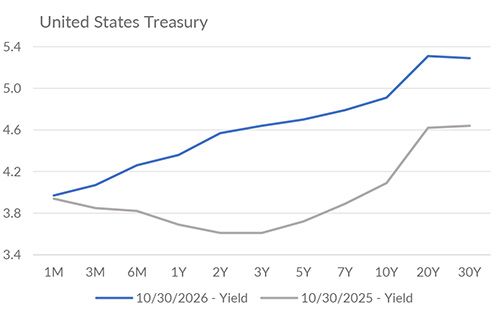
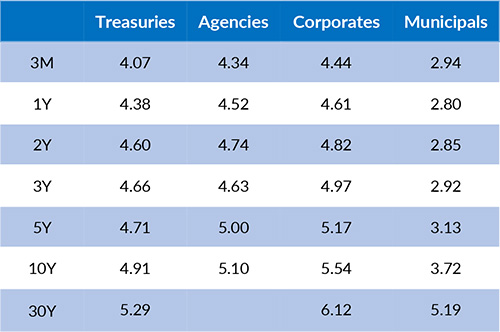
The Federal Reserve maintained the federal funds target range at 3.75%-4.00% at its October meeting, following a 25 basis point increase in September. The decision passed by a 10-to-2 vote, with both dissenting members preferring another 25-basis-point increase. Futures markets currently assign a 75% probability to a December rate increase. Treasury yields declined during the second half of October as strong Treasury auctions, tighter financial conditions, and increased demand for government securities reversed part of September’s selloff. The 2-year Treasury yield ended October at 4.57%, down around 20 basis points during the month, while the 10-year yield declined over 30 basis points to 4.91%. After a volatile past two months, the US Aggregate Bond Index is down just 0.68% year to date.
Yield Curve
Current Generic Bond Yields
Equities
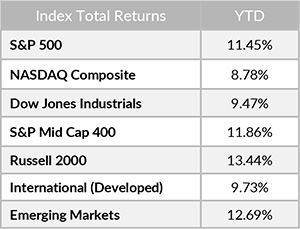
Market leadership shifted during the second half of October as large-cap technology stocks underperformed both small-cap and equal-weight benchmarks. During the month, the Nasdaq Composite fell 5.32%, while the S&P 500 fell 1.08%, and the equal-weight S&P 500 advanced 4.45%. Third-quarter earnings results for the S&P 500 remain strong up to this point, with blended earnings growth of 22.6% for the Magnificent 7, compared with 32.6% for the other 493 companies in the index. Attention has increasingly turned toward whether elevated artificial intelligence infrastructure spending will ultimately translate into stronger profitability and free cash flow.
In 2026, the best performing U.S. sectors have been Energy (+59.92%), Health Care (+21.02%), and Information Technology (+19.65%). The worst performing sectors have been Communication Services (-11.31%), Consumer Discretionary (-2.11%), and Utilities (+3.94%). On a total return basis, the Russell 1000 Growth Index returned 1.31% year to date, while the Russell 1000 Value Index increased 23.21% over the same period.
{"dialogBean":{"articleAbstract":"The Atlanta Fed GDPNow model currently estimates fourth-quarter real GDP growth at a 3.7% annualized rate, up from its initial estimate of 3.2%.","priority":"1","isFeatured":"false","isNews":"false","hideInBlogLanding":"false","trustmarkDate":"November 01, 2026","trustmarkExpirationDate":"November 08, 2026","authorBean":{"authorName":"Alex Essary","profilePicPath":"/content/dam/trustmark/associates/ef/alex-essary_sm.jpg"}},"pageTitle":"Portfolio Manager Commentary - November 1, 2026","pageThumbnail":"/content/dam/trustmark/advice/commentary/Portfolio-Manager-Commentary_th.jpg","pageTags":["trustmark:investment-management"],"pageTagTitles":["Investment Management"],"pageName":"01-portfolio-manager-commentary","pagePath":"/content/trustmark/trustmark/advice/2026/11/01-portfolio-manager-commentary","externalPagePath":"https://www.trustmark.com/advice/2026/11/01-portfolio-manager-commentary.html","fbAppId":"662611918413208","positioningBean":[{"layout":"small"},{"layout":"large-horizontal"},{"layout":"large-vertical"}]}

Related Articles

October 15, 2026
In September, the ISM Services PMI registered 54.9, down from 55.4 in August but marking the 27th consecutive month of expansion in the services sector.

October 1, 2026
The Atlanta Fed GDPNow model currently estimates third-quarter real GDP growth of 3.7% (versus consensus of 2.6%), revised from 4.8% one month ago.

September 15, 2026
The ISM Services PMI increased to 55.4 in August from 54.1 in July, reaching its highest level in six months.