
April 15, 2026

We use cookies on this site to improve the user experience and analyze website traffic. To learn more about how we use cookies, please see our Manage Cookies page. You can adjust your cookie settings to allow only specific types of cookies. By continuing to use our site, you are agreeing to our Privacy Policy and cookies usage.


Economic Outlook
In March, the ISM Services PMI registered 54.0, indicating continued expansion in the services sector. The NFIB Small Business Optimism Index fell to 95.8 in March, the lowest level since April 2025. Labor market conditions improved in March, with non-farm payrolls rising by 178,000 and the unemployment rate falling to 4.3%, the lowest level in 6 months. However, average hourly earnings increased by just 3.5% from a year ago, the lowest increase since May 2021. Inflation accelerated in March, with the Consumer Price Index rising 3.3% from a year ago. Producer prices increased 4.0% over the same period. Consumer sentiment has fallen sharply over the past two months, with the University of Michigan index posting a preliminary April reading of 47.6, the lowest in the survey’s history. The average interest rate for a 30-year fixed-rate mortgage was approximately 6.42% as of April 10.
Fixed Income
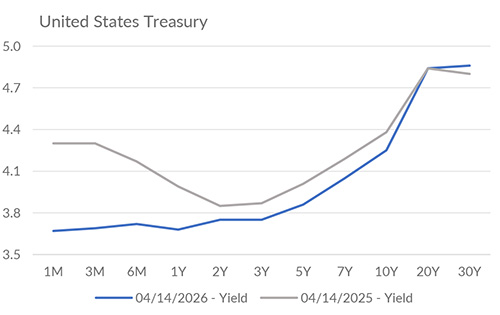
The federal funds target range remains 3.50%–3.75% following the March FOMC meeting, where policymakers held rates steady and continued to project around one rate cut in 2026. Treasury markets have become more cautious in recent weeks as the Iran conflict has lifted oil prices and pushed inflation expectations higher, leading some Fed officials to suggest that rate cuts could be delayed well into 2027 if price pressures persist. High-yield spreads have narrowed after recent volatility and remain at the low end of their historical range, currently in the 5th percentile since 2001. This stability indicates that despite ongoing geopolitical uncertainty and continued scrutiny surrounding private credit, credit markets are not materially repricing risk. Looking ahead, fixed income markets appear to be pricing in a higher-for-longer rate environment.
Yield Curve
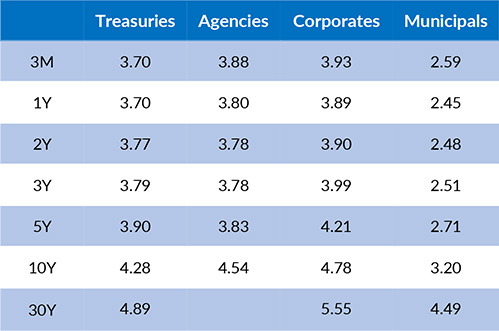
Current Generic Bond Yields
Equities
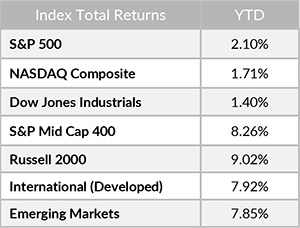
U.S. equities have rebounded in April, with the S&P 500 up 6.4%, NASDAQ Composite up 9.4%, and Dow Jones up 3.8%. The NASDAQ Composite has traded higher for ten consecutive sessions, the longest streak since 2021. Market breadth has improved modestly over the past two weeks, as the percentage of S&P 500 stocks trading above their 200-day moving average has moved from 42% to 55%. Since April 1, seven of the eleven S&P 500 sectors have moved higher, with Energy a laggard. Notably, earnings expectations have continued to improve even amidst the ongoing Iran conflict, with estimates for S&P 500 EPS growth in 2026 rising from 14.6% at the end of February to 18.3% today.
In 2026, the best performing U.S. sectors have been Energy (+25.70%), Materials (+14.81%), and Industrials (+12.13%). The worst performing sectors have been Financials (-4.97%), Health Care (-3.48%), and Consumer Discretionary (-1.21%). On a total return basis, the Russell 1000 Growth Index returned -2.53% year to date, while the Russell 1000 Value Index increased 7.31% over the same period.
{"dialogBean":{"articleAbstract":"In March, the ISM Services PMI registered 54.0, indicating continued expansion in the services sector.","priority":"1","isFeatured":"false","isNews":"false","hideInBlogLanding":"false","trustmarkDate":"April 15, 2026","trustmarkExpirationDate":"September 22, 2026","authorBean":{"authorName":"Alex Essary","profilePicPath":"/content/dam/trustmark/associates/ef/alex-essary_sm.jpg"}},"pageTitle":"Portfolio Manager Commentary - April 15, 2026","pageThumbnail":"/content/dam/trustmark/advice/commentary/Portfolio-Manager-Commentary_th.jpg","pageTags":["trustmark:investment-management"],"pageTagTitles":["Investment Management"],"pageName":"15-portfolio-manager-commentary","pagePath":"/content/trustmark/trustmark/advice/2026/4/15-portfolio-manager-commentary","externalPagePath":"https://www.trustmark.com/advice/2026/4/15-portfolio-manager-commentary.html","fbAppId":"662611918413208","positioningBean":[{"layout":"small"},{"layout":"large-horizontal"},{"layout":"large-vertical"}]}

Related Articles

April 1, 2026
The Atlanta Federal Reserve currently estimates real GDP growth of 1.9% for Q1 2026, pointing to slower but still positive activity for the period.

March 15, 2026
In February, the ISM Services PMI registered 56.1, indicating the fastest growth in the services sector since August 2022.

March 1, 2026
The Atlanta Federal Reserve currently estimates real GDP growth of 3.0% for Q1 2026, suggesting continued underlying economic resilience.