
June 15, 2026

We use cookies on this site to improve the user experience and analyze website traffic. To learn more about how we use cookies, please see our Manage Cookies page. You can adjust your cookie settings to allow only specific types of cookies. By continuing to use our site, you are agreeing to our Privacy Policy and cookies usage.


Economic Outlook
In May, the ISM Services PMI increased to 54.5, the strongest gain in three months. Industrial Production rose by 1.7% from a year ago, indicating resilience in the manufacturing sector. The NFIB Small Business Optimism Index fell to 95.3, with the NFIB’s Chief Economist noting unpredictable fuel prices as a challenge disproportionately impacting small businesses. Labor market conditions remained relatively stable, with Nonfarm Payrolls increasing by 172,000 in May. For the third consecutive month, the U.S. unemployment rate held at 4.3%. Inflation continued to accelerate in May, with the Consumer Price Index rising 4.2% from a year ago. Producer prices increased 6.5% over the same period, the highest rate since November 2022. The NAHB Housing Market Index fell to 35.0 in June, with 35% of homebuilders reporting price cuts. The average interest rate for a 30-year fixed-rate mortgage was approximately 6.52% as of June 11.
Fixed Income
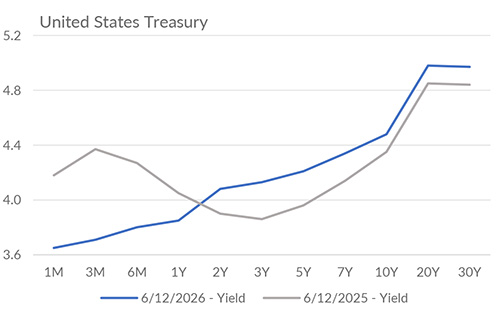
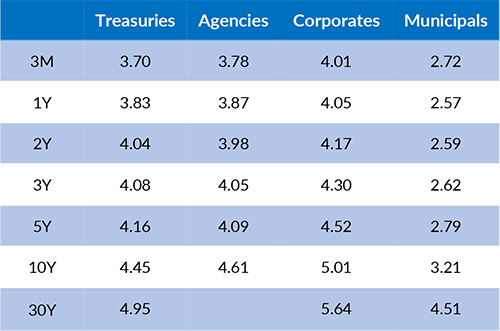
The upcoming June 16-17 meeting will mark Kevin Warsh’s first meeting as Chair of the Federal Reserve. The Federal Open Market Committee is widely expected to hold the target rate at 3.50%-3.75%. Markets will focus closely on any changes in communication regarding inflation risks, labor market conditions, and the future policy path. As policy expectations have shifted modestly in recent months, Treasury yields have also moved higher, with the 30-year Treasury yield rising to its highest levels since 2007. After spiking in mid-May, the 30-year Treasury yield has since retreated around 20 basis points. The Treasury yield curve remains nearly unchanged from a month ago. Meanwhile, the ICE BofA MOVE Index has fallen to 69 compared to a high in March of 115, indicating that options markets are pricing in lower levels of bond market volatility.
Yield Curve
Current Generic Bond Yields
Equities
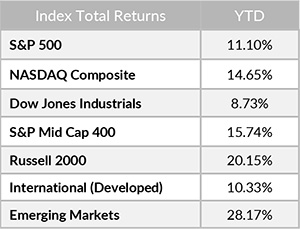
The S&P 500 lost momentum at the start of June, resulting in a brief 4.5% drawdown. However, the index now sits near all-time highs amid consecutive strong trading sessions. Market leadership has broadened considerably, as small-cap stocks, value-oriented companies, and international markets have all participated in the rally. Investors now face pockets of elevated equity valuations alongside an increase in equity supply. Notably, SpaceX completed the largest IPO in history last week, providing one of the first major tests of investor demand during a new cycle of increasing equity issuance.
In 2026, the best performing U.S. sectors have been Energy (+28.73%), Information Technology (+17.77%), and Materials (+13.99%). The worst performing sectors have been Financials (-2.05%), Consumer Discretionary (-1.54%), and Health Care (-0.18%). On a total return basis, the Russell 1000 Growth Index returned 5.36% year to date, while the Russell 1000 Value Index increased 16.14% over the same period.
{"dialogBean":{"articleAbstract":"In May, the ISM Services PMI increased to 54.5, the strongest gain in three months.","priority":"1","isFeatured":"false","isNews":"false","hideInBlogLanding":"false","trustmarkDate":"June 15, 2026","trustmarkExpirationDate":"August 25, 2026","authorBean":{"authorName":"Alex Essary","profilePicPath":"/content/dam/trustmark/associates/ef/alex-essary_sm.jpg"}},"pageTitle":"Portfolio Manager Commentary - June 15, 2026","pageThumbnail":"/content/dam/trustmark/advice/commentary/Portfolio-Manager-Commentary_th.jpg","pageTags":["trustmark:investment-management"],"pageTagTitles":["Investment Management"],"pageName":"15-portfolio-manager-commentary","pagePath":"/content/trustmark/trustmark/advice/2026/6/15-portfolio-manager-commentary","externalPagePath":"https://www.trustmark.com/advice/2026/6/15-portfolio-manager-commentary.html","fbAppId":"662611918413208","positioningBean":[{"layout":"small"},{"layout":"large-horizontal"},{"layout":"large-vertical"}]}

Related Articles

June 1, 2026
The Atlanta Federal Reserve currently estimates real GDP growth of approximately 3.0% for Q2 2026, suggesting continued economic resilience.


May 1, 2026
The Atlanta Federal Reserve currently estimates real GDP growth of approximately 3.5% for Q2 2026, suggesting continued underlying economic resilience.