
July 15, 2026

We use cookies on this site to improve the user experience and analyze website traffic. To learn more about how we use cookies, please see our Manage Cookies page. You can adjust your cookie settings to allow only specific types of cookies. By continuing to use our site, you are agreeing to our Privacy Policy and cookies usage.


Economic Outlook
In June, the ISM Services PMI registered 54.0, marking the 24th consecutive month of expansion for the services sector. The employment subcomponent expanded for the first time in four months, its largest increase since 2024. Small business sentiment improved, with the NFIB Small Business Optimism Index rising to 97.4 from 95.3 in May. Consumer sentiment improved from the prior month, with the University of Michigan Consumer Sentiment Index rising to 49.5 from 44.8 in May, although the index remains well below its long-run average. Labor market conditions showed further moderation, with nonfarm payrolls increasing by 57,000 in June and the unemployment rate improved slightly to 4.2%. Inflation eased during the month, as the Consumer Price Index declined 0.4% from May while increasing 3.5% year-over-year. Producer prices increased 2.9% from a year ago in June, down from 3.7% in May, suggesting inflation pressures at the wholesale level continued to moderate. The average interest rate for a 30-year fixed-rate mortgage was approximately 6.49% as of July 9.
Fixed Income
Treasury yields have spent much of the past several months moving higher, with the 2-year Treasury yield rising to a recent high near 4.27%.. Amid the recent rise in rates, the 2-year Treasury yield is above the federal funds rate by its widest margin since November 2022. The bond market continues to assign meaningful odds to additional policy restraint. Recent comments from Federal Reserve Chair Kevin Warsh have reinforced that view, including his statement that policymakers have “no tolerance for persistently elevated inflation” and remain committed to restoring price stability. Following this week's inflation data releases, the 2-year Treasury yield declined sharply from its recent high. Futures markets currently price approximately 25-50 basis points of rate cuts by year-end. Attention will now turn to the upcoming FOMC meeting later this month, where investors will look for confirmation that recent progress on inflation is sufficient to keep monetary policy on its expected path.
Yield Curve
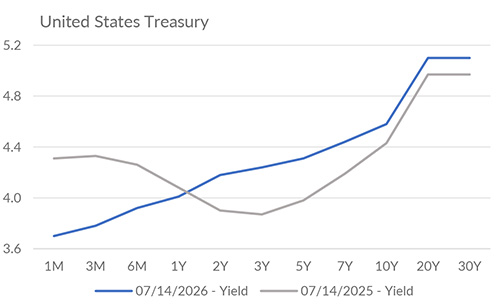
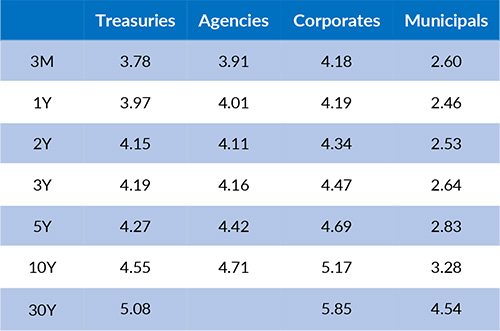
Current Generic Bond Yields
Equities
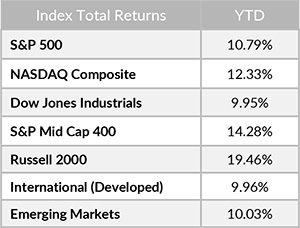
The S&P 500 continued to advance during the first half of July, supported by expectations for 24.2% year-over-year earnings growth during Q2 2026. Notably, expectations have broadened beyond a handful of large-cap technology companies, with multiple sectors expected to deliver double-digit earnings growth. Similarly, net profit margins are expected to remain near the highest levels since at least 2009, following a record quarter in Q1 of this year. With the S&P 500 trading at a trailing P/E of approximately 27.51, expectations remain elevated heading into earnings season.
In 2026, the best performing U.S. sectors have been Energy (+28.27%), Information Technology (+18.81%), and Industrials (+16.96%). The worst performing sectors have been Consumer Discretionary (-1.12%), Health Care (+3.13%), and Financials (+3.49%). On a total return basis, the Russell 1000 Growth Index returned 4.47% year to date, while the Russell 1000 Value Index increased 18.03% over the same period.
{"dialogBean":{"articleAbstract":"In June, the ISM Services PMI registered 54.0, marking the 24th consecutive month of expansion for the services sector.","priority":"1","isFeatured":"false","isNews":"false","hideInBlogLanding":"false","trustmarkDate":"July 15, 2026","trustmarkExpirationDate":"September 20, 2026","authorBean":{"authorName":"Alex Essary","profilePicPath":"/content/dam/trustmark/associates/ef/alex-essary_sm.jpg"}},"pageTitle":"Portfolio Manager Commentary - July 15, 2026","pageThumbnail":"/content/dam/trustmark/advice/commentary/Portfolio-Manager-Commentary_th.jpg","pageTags":["trustmark:investment-management"],"pageTagTitles":["Investment Management"],"pageName":"15-portfolio-manager-commentary","pagePath":"/content/trustmark/trustmark/advice/2026/7/15-portfolio-manager-commentary","externalPagePath":"https://www.trustmark.com/advice/2026/7/15-portfolio-manager-commentary.html","fbAppId":"662611918413208","positioningBean":[{"layout":"small"},{"layout":"large-horizontal"},{"layout":"large-vertical"}]}

Related Articles

July 1, 2026
The Atlanta Fed GDPNow model currently estimates second quarter real GDP growth of 1.2%, down from 3.0% one month ago.


June 1, 2026
The Atlanta Federal Reserve currently estimates real GDP growth of approximately 3.0% for Q2 2026, suggesting continued economic resilience.