
September 1, 2026

We use cookies on this site to improve the user experience and analyze website traffic. To learn more about how we use cookies, please see our Manage Cookies page. You can adjust your cookie settings to allow only specific types of cookies. By continuing to use our site, you are agreeing to our Privacy Policy and cookies usage.


Economic Outlook
The Atlanta Federal Reserve estimates real GDP growth of 4.8% for Q3 2026. The Conference Board Leading Economic Index increased 0.2% in July to 99.5. The index’s six-month growth rate turned positive for the first time in more than four years. The ISM Manufacturing PMI registered 54.6 in August, down from 55.6 in July but marking the eighth consecutive month of expansion in manufacturing activity. Consumer sentiment declined in August, with the University of Michigan Consumer Sentiment Index posting a final reading of 51.7, down from 55.2 in July. The NAHB Housing Market Index increased marginally to 35 in August, reflecting multi-year lows in homebuilder confidence. The 5-year breakeven inflation rate was 2.31% at the end of August, up slightly from 2.26% at the end of July. The average interest rate for a 30-year fixed-rate mortgage was approximately 6.66% as of August 27.
Fixed Income
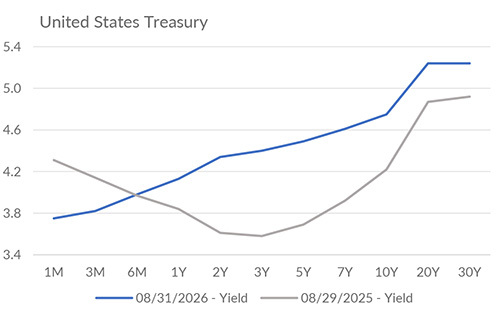
The federal funds target range remains at 3.50%-3.75%, with futures markets pricing in dwindling odds of additional policy tightening at the September FOMC meeting. Treasury yields moved modestly higher during August, with the 2-year Treasury yield ending the month near 4.36%, while the 10-year and 30-year Treasury yields closed at approximately 4.78% and 5.27%, respectively. Treasury issuance and federal borrowing requirements remained a key market focus during the month, with recent comments from Treasury Secretary Scott Bessent highlighting the importance of stabilizing long-term borrowing costs and a continued focus on Treasury issuance strategy. The Bloomberg U.S. Aggregate Bond Index has generated a total return of approximately -0.48% year to date, as higher Treasury yields have offset much of the income generated by underlying securities.
Yield Curve
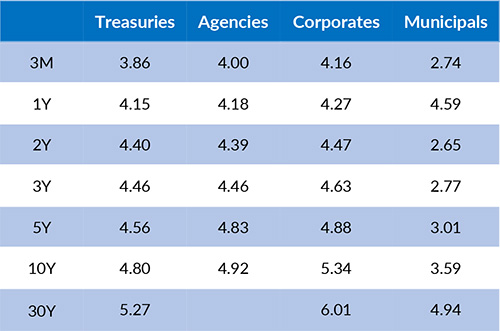
Current Generic Bond Yields
Equities
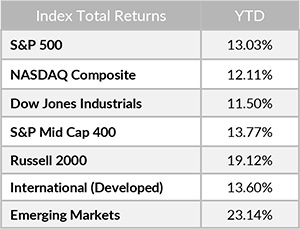
U.S. equity markets advanced during August, with the S&P 500 gaining approximately 2.7% for the month. Software stocks were among the strongest performers during August following a challenging first half of the year. Despite continued headlines surrounding the conflict with Iran, Treasury market intervention, and ongoing trade tensions, equity market volatility remained subdued, with the VIX Index little changed over the past three months. Second quarter earnings season reinforced the continued acceleration in artificial intelligence-related investment spending. Looking ahead, analysts currently estimate S&P 500 earnings growth of approximately 28% for the third quarter.
In 2026, the best performing U.S. sectors have been Energy (+44.20%), Information Technology (+22.88%), and Materials (+16.69%). The worst performing sectors have been Consumer Discretionary (+0.00%), Communication Services (+0.14%), and Utilities (+0.27%). On a total return basis, the Russell 1000 Growth Index returned 3.69% year to date, while the Russell 1000 Value Index increased 21.69% over the same period.
{"dialogBean":{"articleAbstract":"The Atlanta Federal Reserve estimates real GDP growth of 4.8% for Q3 2026.","priority":"1","isFeatured":"false","isNews":"false","hideInBlogLanding":"false","trustmarkDate":"September 01, 2026","trustmarkExpirationDate":"September 20, 2026","authorBean":{"authorName":"Alex Essary","profilePicPath":"/content/dam/trustmark/associates/ef/alex-essary_sm.jpg"}},"pageTitle":"Portfolio Manager Commentary - September 1, 2026","pageThumbnail":"/content/dam/trustmark/advice/commentary/Portfolio-Manager-Commentary_th.jpg","pageTags":["trustmark:investment-management"],"pageTagTitles":["Investment Management"],"pageName":"01-portfolio-manager-commentary","pagePath":"/content/trustmark/trustmark/advice/2026/9/01-portfolio-manager-commentary","externalPagePath":"https://www.trustmark.com/advice/2026/9/01-portfolio-manager-commentary.html","fbAppId":"662611918413208","positioningBean":[{"layout":"small"},{"layout":"large-horizontal"},{"layout":"large-vertical"}]}

Related Articles

August 15, 2026
In July, the ISM Services PMI registered 54.1, marking the 25th consecutive month of expansion and highlighting the continued resilience of the U.S. services sector, which accounts for the majority of economic activity.

August 1, 2026
The Atlanta Federal Reserve currently estimates real GDP growth of 6.2% for Q3 2026, well above the consensus estimate of approximately 2.0%.

July 15, 2026
In June, the ISM Services PMI registered 54.0, marking the 24th consecutive month of expansion for the services sector.