
September 15, 2026

We use cookies on this site to improve the user experience and analyze website traffic. To learn more about how we use cookies, please see our Manage Cookies page. You can adjust your cookie settings to allow only specific types of cookies. By continuing to use our site, you are agreeing to our Privacy Policy and cookies usage.


Economic Outlook
The ISM Services PMI increased to 55.4 in August from 54.1 in July, reaching its highest level in six months. Business activity, new orders, and inventories rose faster during the month, while the employment component remained in contraction territory. The NFIB Small Business Optimism Index remained near its highest level of 2026, although expectations for better business conditions deteriorated. Labor market conditions improved during August, with nonfarm payrolls increasing by 162,000. The unemployment rate remained unchanged at 4.1%, while labor-force participation increased to 61.6%. The Consumer Price Index increased 0.4% in August and rose 3.4% from a year ago, unchanged from July’s annual rate. Core inflation moderated to 2.4% year-over-year from 2.5% in July. The Producer Price Index increased 0.4% in August and rose 5.4% from a year ago, with higher energy prices contributing to the monthly increase. The average interest rate for a 30-year fixed-rate mortgage was 6.76% as of September 10, 2026.
Fixed Income
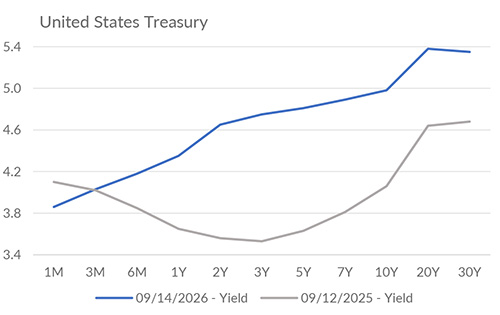
The federal funds target range remains at 3.50%-3.75% ahead of the September FOMC meeting. August inflation data surprised slightly to the upside, with both consumer and producer prices accelerating during the month. As a result, futures markets indicate a greater than 90% probability of a rate hike at this week’s meeting, with one additional rate hike expected by year-end. The 2-year Treasury yield has moved higher in recent weeks, while longer-term Treasury yields remain near their highest levels in nearly two decades. Elevated energy prices and ongoing fiscal deficits have contributed to concerns that inflation may prove more persistent than previously expected. Despite higher market volatility, the Treasury yield curve remains positively sloped, and income opportunities across fixed income markets remain among the most attractive available in recent years. Corporate credit spreads have remained relatively stable, suggesting investors continue to view corporate fundamentals favorably despite a higher interest-rate environment.
Yield Curve
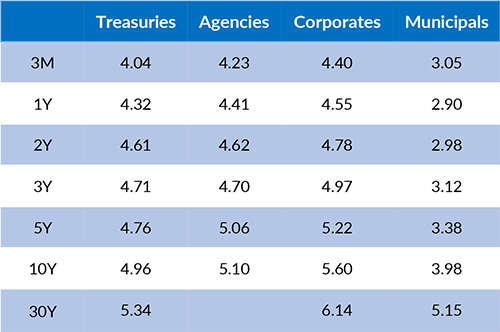
Current Generic Bond Yields
Equities
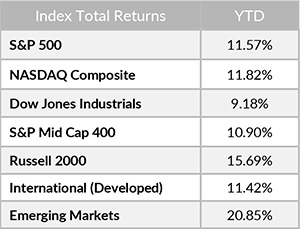
One of the defining characteristics of 2026 has been the market's continued transition of pricing artificial intelligence as a broader economic theme. While Technology remains one of the strongest-performing sectors and continues to benefit from accelerating artificial intelligence-related investment spending, investors have increasingly focused on the infrastructure required to support that growth. Energy, Materials, and Industrials have been among the strongest-performing sectors this year as markets price the power generation, electrical equipment, manufacturing capacity, and physical infrastructure necessary to support expanding computational demand. Currently, the S&P 500 trailing P/E valuation sits at 25.2, above its 5 year (24.9) and 10 year (21.9) median levels.
In 2026, the best performing U.S. sectors have been Energy (+46.17%), Information Technology (+21.58%), and Materials (+11.69%). The worst performing sectors have been Consumer Discretionary (-3.00%), Utilities (-0.69%), and Financials (+5.11%). On a total return basis, the Russell 1000 Growth Index returned 1.77% year to date, while the Russell 1000 Value Index increased 20.45% over the same period.
{"dialogBean":{"articleAbstract":"The ISM Services PMI increased to 55.4 in August from 54.1 in July, reaching its highest level in six months.","priority":"1","isFeatured":"false","isNews":"false","hideInBlogLanding":"false","trustmarkDate":"September 15, 2026","trustmarkExpirationDate":"October 25, 2026","authorBean":{"authorName":"Alex Essary","profilePicPath":"/content/dam/trustmark/associates/ef/alex-essary_sm.jpg"}},"pageTitle":"Portfolio Manager Commentary - September 15, 2026","pageThumbnail":"/content/dam/trustmark/advice/commentary/Portfolio-Manager-Commentary_th.jpg","pageTags":["trustmark:investment-management"],"pageTagTitles":["Investment Management"],"pageName":"15-portfolio-manager-commentary","pagePath":"/content/trustmark/trustmark/advice/2026/9/15-portfolio-manager-commentary","externalPagePath":"https://www.trustmark.com/advice/2026/9/15-portfolio-manager-commentary.html","fbAppId":"662611918413208","positioningBean":[{"layout":"small"},{"layout":"large-horizontal"},{"layout":"large-vertical"}]}

Related Articles


August 15, 2026
In July, the ISM Services PMI registered 54.1, marking the 25th consecutive month of expansion and highlighting the continued resilience of the U.S. services sector, which accounts for the majority of economic activity.

August 1, 2026
The Atlanta Federal Reserve currently estimates real GDP growth of 6.2% for Q3 2026, well above the consensus estimate of approximately 2.0%.